Monday, July 31, 2017

To Autumn : BY JOHN KEATS


Season of mists and mellow fruitfulness, 
   Close bosom-friend of the maturing sun; 
Conspiring with him how to load and bless 
   With fruit the vines that round the thatch-eves run; 
To bend with apples the moss'd cottage-trees, 
   And fill all fruit with ripeness to the core; 
      To swell the gourd, and plump the hazel shells 
   With a sweet kernel; to set budding more, 
And still more, later flowers for the bees, 
Until they think warm days will never cease, 
      For summer has o'er-brimm'd their clammy cells. 

Who hath not seen thee oft amid thy store? 
   Sometimes whoever seeks abroad may find 
Thee sitting careless on a granary floor, 
   Thy hair soft-lifted by the winnowing wind; 
Or on a half-reap'd furrow sound asleep, 
   Drows'd with the fume of poppies, while thy hook 
      Spares the next swath and all its twined flowers: 
And sometimes like a gleaner thou dost keep 
   Steady thy laden head across a brook; 
   Or by a cyder-press, with patient look, 
      Thou watchest the last oozings hours by hours. 

Where are the songs of spring? Ay, Where are they? 
   Think not of them, thou hast thy music too,— 
While barred clouds bloom the soft-dying day, 
   And touch the stubble-plains with rosy hue; 
Then in a wailful choir the small gnats mourn 
   Among the river sallows, borne aloft 
      Or sinking as the light wind lives or dies; 
And full-grown lambs loud bleat from hilly bourn; 
   Hedge-crickets sing; and now with treble soft 
   The red-breast whistles from a garden-croft
      And gathering swallows twitter in the skies.

Click: https://www.poetryfoundation.org/poems/44484/to-autumn


Important links for Romantic Poetry: Poem by William Blake

http://www.gutenberg.us/articles/eng/The_Chimney_Sweeper


THE POEMS

Songs of Innocence:
The Chimney Sweeper
When my mother died I was very young,
And my father sold me while yet my tongue
Could scarcely cry 'weep! 'weep! 'weep! 'weep![1]
So your chimneys I sweep, and in soot I sleep.

There's little Tom Dacre, who cried when his head,
That curled like a lamb's back, was shaved: so I said,
"Hush, Tom! never mind it, for when your head's bare,
You know that the soot cannot spoil your white hair."

And so he was quiet; and that very night,
As Tom was a-sleeping, he had such a sight, -
That thousands of sweepers, Dick, Joe, Ned, and Jack,
Were all of them locked up in coffins of black.

And by came an angel who had a bright key,
And he opened the coffins and set them all free;
Then down a green plain leaping, laughing, they run,
And wash in a river, and shine in the sun.

Then naked and white, all their bags left behind,
They rise upon clouds and sport in the wind;
And the angel told Tom, if he'd be a good boy,
He'd have God for his father, and never want joy.

And so Tom awoke; and we rose in the dark,
And got with our bags and our brushes to work.
Though the morning was cold, Tom was happy and warm;
So if all do their duty they need not fear harm.
Songs of Experience:
THE Chimney Sweeper
A little black thing among the snow,
Crying "'weep! 'weep!" in notes of woe!
"Where are thy father and mother? Say!"--
"They are both gone up to the church to pray.

"Because I was happy upon the heath,
And smiled among the winter's snow,
They clothed me in the clothes of death,
And taught me to sing the notes of woe.

"And because I am happy and dance and sing,
They think they have done me no injury,
And are gone to praise God and his priest and king,
Who make up a heaven of our misery.


The Chimney Sweeper" is the title of two poems by William Blake, published in Songs of Innocence in 1789 and Songs of Experience in 1794.[2] The poem "The Chimney Sweeper" is set against the dark background of child labour that was prominent in England in the late XVIII and XIX Century. At the age of four and five, boys were sold to clean chimneys, due to their small size. These children were oppressed and had a diminutive existence that was socially accepted at the time. In the earlier poem, a young chimney sweeper recounts a dream had by one of his fellows, in which an angel rescues the boys from coffins and takes them to a sunny meadow; in the later poem, an apparently adult speaker encounters a child chimney sweeper abandoned in the snow while his parents are at church or possibly even suffered death where church is referring to being with God.

IENG syllabus

                                           B. TECH. SEMESTER I/II
SUBJECT NAME: INTERACTIVE ENGLISH (IENG)
NO. OF CREDITS: 3

Course Objective:
To read and discuss text of a chosen Shakespearean tragedy and make students familiar with Romantic poetry in English literature so as to help the students enhance their understanding of value of literature in wider socio-historical context by evoking examples from  Elizabethan England, the French revolution and Industrial revolution. Thereby to furnish examples from the literary canon to be first emulated and later critiqued in creative and critical writing. At the same time, to hone the skills of students in written communication by working on the vocabulary of students so they can express themselves clearly and persuasively.


Unit –I- Literature
Shakespeare’s Macbeth(story adaptation of play); Romantic poetry-    ‘The Chimney Sweeper’ by Blake, ‘To Autumn’ by John Keats, 'The Rainbow' by William Wordsworth, ‘Ozymandias’ by PB Shelley,  ‘The Rime of the Ancient Mariner’ (text of 1834) –Part-I and Part-II by Samuel Coleridge, Historical context of Romantic poetry-French Revolution and Industrial revolution.

Unit-II-Functional English
Report Writing- hypothesis-evidence-thesis, Proposals/Feasibility and Progress Reports/Memo/Letter formats; Essays/paragraphs; applications; description of objects, appliances, instruments, products, processes.

Unit-III- Critical thinking & Creative Writing
Critical thinking; creative writing exercises; Seven Cs of writing/ Story composition/news reports/ feature writing/verse composition, Paraphrasing poems, comprehending Unseen Passages, writing biographies, art of interviewing, book reviews.

Unit –IV-Semantics and Syntax
Antonyms, synonyms, homophones, words often confused, one word substitutes, word origins, sentence correction/error correction exercises in basic grammar.

COURSE OUTCOMES:

Course Outcomes: At the end of the course the students will be able to:
·         Students are conversant with representative texts of Shakespeare and Romantic poetry. They also understand the historical context of these literary works.
·         Students are able to communicate effectively in corporate environment.
·         Inculcate critical thinking and demonstrate an ability to articulate their thoughts coherently and creatively.
·         Command a better vocabulary and express their thoughts clearly and precisely.

References:
1.      Shakespeare Readers. VolumeI. Macbeth.Scholastic India, 2016.
2.      Michael Neill, David Schalkwyk.The Oxford Handbook of Shakespearean Tragedy. Oxford UP. 2016
3.      Claire McEachern.The Cambridge Companion to Shakespearean Tragedy. Cambridge UP. 2013
4.      RC Sharma and Krishna Mohan. 4th edition. Business Correspondence and Report Writing. McGraw Hill.
5.      Bretag, Crossman, and Bordia. Communictaion Skills.TatMcGraw Hill.2012
6.      A.C. Bradley and John Bayley. Shakespearean Tragedy. Penguin Books.1991

Other background readings:
1.      Das, ManojTales Told by Mystics. SahityaAkademi. New Delhi 2001
2.      UshaBande. Pointed Vision: An Anthology of Short Stories. Oxford UP. 2002
3.      Reference material consisting of poems and material related to Romantic poetry to be circulated by the teacher consisting of introductory notes on French revolution and industrial revolution.


LANGUAGE LAB

Objective: To guide the students to improve their conversational and linguistic skills including better command over spoken English.  Introduce students to various scenarios to help them opt for appropriate responses on interpersonal level.


CORPORATE INTERACTION & COMMUNICATION
I.                   Presentations
II.                 Listening Skills & Language Lab (Practical) Interviews of Isaac Asimov, Richard Feynman, Steve Jobs and other scientists and technocrats. Other inspiring speeches on social issues as well as related to the corporate world and industry; Audio/Video Lessons and Observation
III.             Group Discussions, Corporate Dialogue: Conflict-Resolution exercises; Role Play; Mock-interviews.
IV.             Internal Assessment: based on participation, short presentation & performance in interactive exercises: competence gauged through participation in various events organized in the classroom and at university level throughout the semester.

Outcome:
·         The students will be trained to respond better to new scenarios that demand good communication skills.
·         The students will be able to resolve potential conflicts by avoiding communication gaps and overcoming barriers.
·         Students will learn to use skills effectively for enhancing performance and even improving upon their power to persuade.

References:
·         Language Lab Software


Story adapted from Shakespeare's Macbeth:


Source: Shakespeare Readers. Volume I. Macbeth. retold by Aishwarya Subramanian.Scholastic India Pvt.Ltd.2016

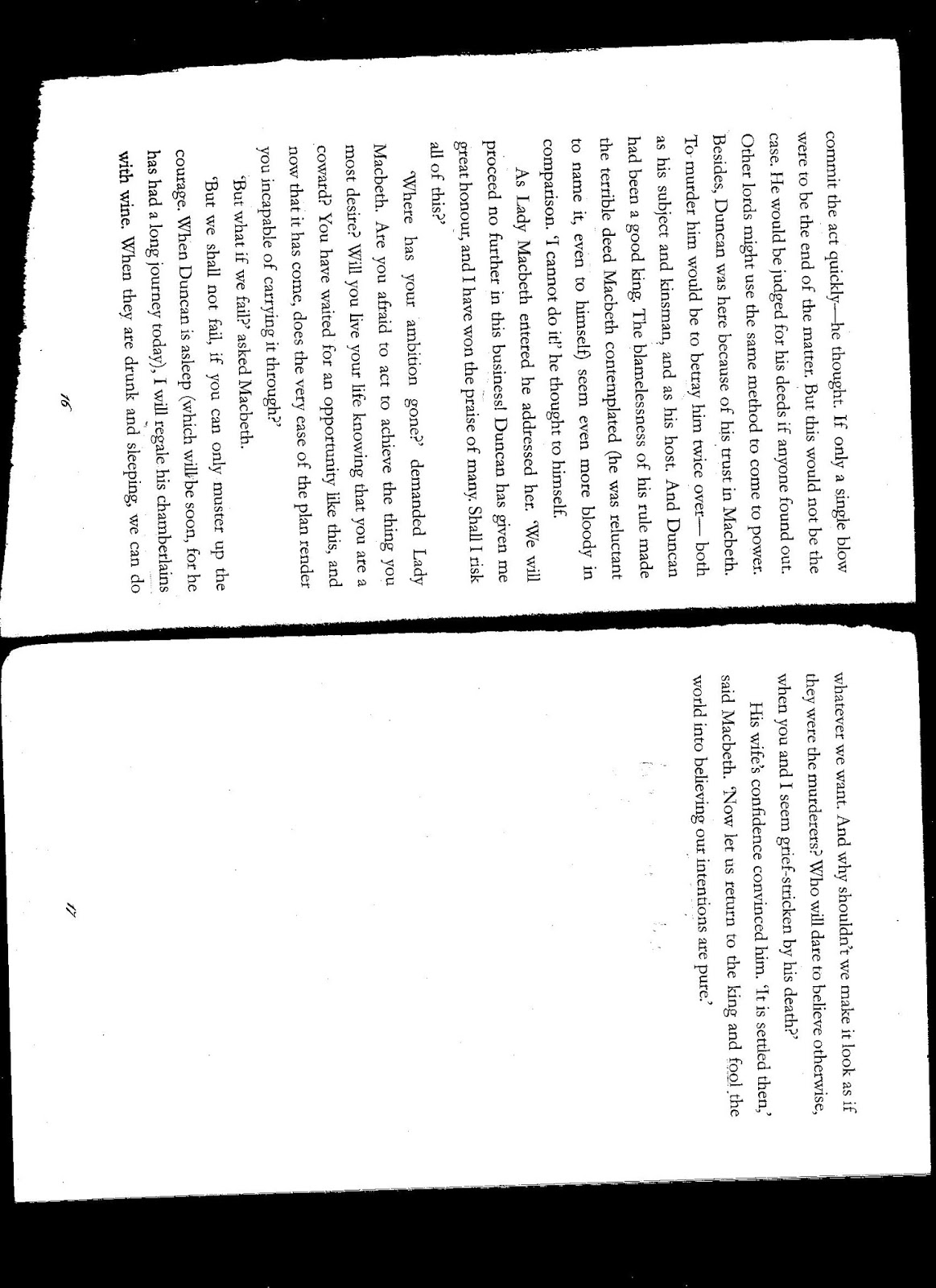
Note: Material circulated within blogger circle for BTech Semester I class of YMCAUST, Fbd.students.to supplement library stock.

Thursday, June 22, 2017

MA(Journalism and Mass Communication)

YMCA University of Science & Technology, Faridabad, Haryana

(UGC 12 B 2(f) status; NAAC 'A' grade)


Activities(2016-17):
1.Internships with Sterling publications and Dainik Tribune(Chandigarh) with focus on media writing and editing.
2.Documentary –making and in-house coverage.
3.Blogging
4.Ours students had experience with content development(writing news stories and Press releases)
5.Voice- overs and post-production editing with Dastak India.
6.Learnt Anchoring with BVM.
7.Visit to Thomson printing press
8.Visit to Mughal Gardens
9.Visit to IUAC nuclear accelerator centre, GOI.

Prospects: 
CR station access to Community Radio in pipeline(survey complete for LOI).

Highlights:
Production-oriented course.

Facilities:
Language & Media Lab equipped with Coral draw graphics suite and internet facility.

Monday, April 17, 2017

Make sentences with:

Exercise A: 

Quagmire: area of soft wet ground. Also used for a difficult or dangerous situation. Synonyms: bog, morass

Quaint: attractive in an unusual or old-fashioned way.

Quandary: the state of not being able to decide what to do in a difficult situation.
Synonym: dilemma

Simran was in a quandary-should she write or not?

Quantum: a very small quantity of electromagnetic energy.

Quantum leap: a sudden, great and important change, improvement or development.

Quarry: a place where large amounts of stone etcetra are dug out of the ground.

2. an animal or a person that is being hunted or followed. Synonymonym: prey.

The shutterbugs pursued their quandary through the streets of Mumbai.

Queasy: feeling sick synonym. Nauseous

Queer:L strange or unusual. Synonym. Odd

Quell: to stop something such as violent behavior or protests. Synonym. Calm

This agreement will quell th union’s protests.

Quench: to drink so that you no longer feel thirsty. Synonym. Slake. Synonym. Extinguish.

Firemen tried to quench the flames raging in the building.

Querulous: complaining synonym. Peevish

Quibble: to argue or complain about a small matter or an unimportant detail.

It is not worth quibbling over excess of groceries.

Quid pro quo: a thing that is given in return of sth else.

Quintessence: a perfect example of something.

Quip: a quick and clever remark.

Quirk: an aspect of somebody’s personality or behavior that is a little strange.

Synonym. Peculiarity

2. a strange thing that happens , especially by accident.

By a strange quirk of fate they met again in another part of the world.

Quixotic: having or involving ideas or plans that show imagination but are usually not practical.

Quizzical: showing that you are slightly surprised or amused.

Quotidian : ordinary

The quotidian surface of life hides many wonders.

Precedent: an official action or decision that has happened in the past and that is seen as an example or a rule to be followed in a similar situation later.

Widget: a small device that you do not know trhe name of.

Turnstile: a gate at the entrance to a public building that turns in a circle when pushed, allowing one person to go through at a time.

Hoopla: excitement about something which gets a lot of public attention.

Filibuster: a long speech in parliament in order to delay a vote.

Bellwether: something that is used as a sign of what will happen in the future.

University campuses are considered to be bellwether of socio-economic change.

Canard: a false report or a piece of news.

Turgid: boring, complicated and difficult to understand.

2. swollen; containing more water than usual.

Credible: that can be believed or trusted.

Elocution: the ability to speak clearly and correctly, especially in public and pronouncing the words in a way that is considered to be socially acceptable.

Eloquent: able to use language and express your opinions well, especially when you are speaking in public.

She spoke eloquently on the global issue.

Aver: to state firmly and strongly that something is true.Synonym. Assert; declare

She averred that she had never seen the secret door before.

Alma mater:the school, college or university somebody went to.

Surly: bad-tempered and rude.

Surmise: to guess something using evidence.

Surreal: very strange; more like a dream than reality; with ideas and images mixed together in a strange way.

Swatch: a small piece of cloth

Swathe: a long strip of land, especially one on which the plants or crops have been cut.


Six-Step Case Analysis Process


Step 1: Study the case: 5Ws and 1 H approach: Who, Where , What, Why, When and How of the case are learnt and discussed. That is, the context is understood and reported.

Step 2: Identify the problem and state it.

Step3: Analyze the facts and assumptions.

Step4: List possible alternative solutions.

Step5: Select the best available soloution.

Step6: Develop a plan of action to execute the best solution.

Assignment:

1. With the limited information on demonetization available , analyze the scheme. Suggest better ways in which black money could have been targetted.